
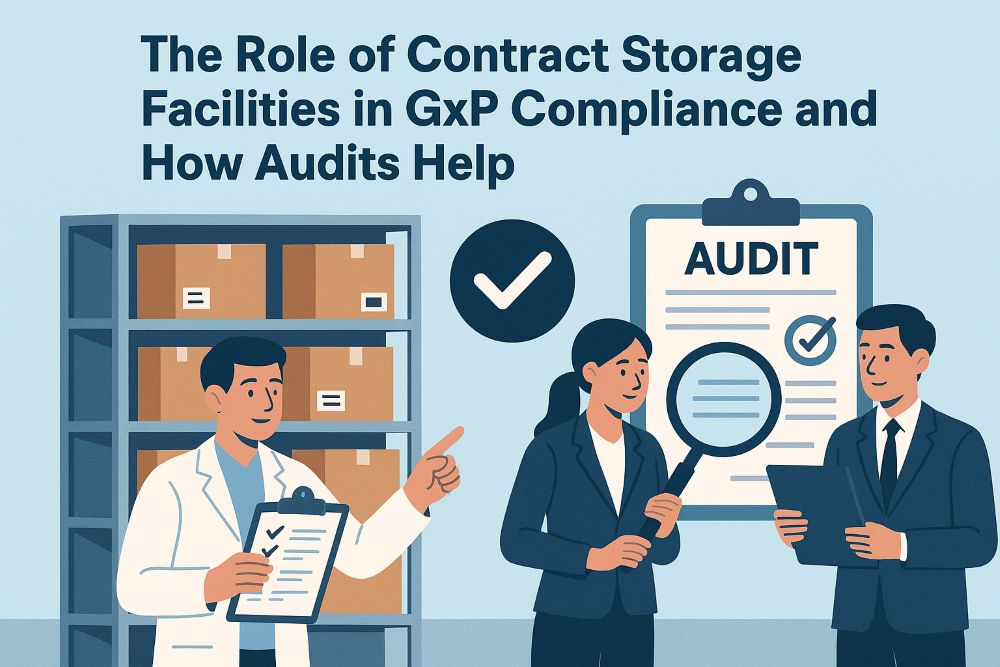
In the pharmaceutical industry, outsourcing is common practice. From manufacturing and packaging to warehousing and distribution, companies often rely on external partners to manage critical parts of the supply chain. Among these, contract storage facilities play a pivotal role in safeguarding medicines before they reach patients.
However, while outsourcing storage offers efficiency and flexibility, it does not remove regulatory responsibility. Pharmaceutical companies remain accountable for compliance with Good Practice (GxP) guidelines,This makes audits of contract storage facilities essential to ensure that medicines are stored safely and in full regulatory compliance.
Why Contract Storage Facilities Are Central to GxP Compliance
- Maintaining Product Quality
Medicines are sensitive to temperature, humidity, and light. Even a minor deviation in storage conditions can compromise product quality. Audits help confirm that facilities have validated systems in place for continuous environmental monitoring. - Regulatory Expectations
Authorities such as the MHRA, EMA, and FDA make it clear: compliance responsibilities remain with the product owner, regardless of outsourcing. Regular audits provide documented assurance that storage partners operate in line with GMP and GDP standards. - Traceability and Documentation
Accurate records of storage conditions, stock movement, and product handling are essential for traceability. Audits verify whether documentation systems meet data integrity standards and regulatory expectations. - Risk Management
Storage facilities face risks such as temperature excursions, cross-contamination, theft, or mishandling. Audits identify vulnerabilities early and ensure robust risk controls are in place.
What Audits of Storage Facilities Cover
When auditing a contract storage facility, pharmaceutical companies typically evaluate:
- Temperature & Humidity Control – validated equipment, calibration, alarms, and cold chain management.
- Storage Layout – segregation of quarantined, returned, or expired products.
- Security & Access Controls – protection against theft or unauthorised entry.
- Quality Systems – SOPs, CAPA management, and training records.
- Documentation & Data Integrity – complete, accurate, and secure audit trails.
- Distribution Practices – checks on transportation, packaging, and handling of products leaving the facility.
How Audits Safeguard Compliance and Patient Safety
Audits of contract storage facilities:
- Provide assurance that GxP standards are consistently applied.
- Demonstrate due diligence to regulators.
- Highlight areas for improvement and drive continuous compliance.
- Reduce the risk of recalls, regulatory actions, or patient harm.
Q&V’s Expertise in Storage Facility Audits
At Q&V, we conduct independent vendor audits of contract storage facilities to ensure they meet GxP compliance requirements. Our auditors apply a risk-based approach, evaluating storage practices, documentation systems, and distribution processes against international standards.
We provide:
- Comprehensive qualification audits for new partners.
- Periodic compliance audits of existing facilities.
- Regulator-ready reports with actionable recommendations.
- Support in implementing corrective and preventive actions (CAPA).
With Q&V’s expertise, you gain confidence that your storage and distribution partners operate with the same high standards that regulators demand from your organisation.
By partnering with Q&V, pharmaceutical companies can strengthen supply chain resilience, ensure full regulatory compliance, and safeguard the quality of medicines from factory to patient.